Free download · Securement and safety
Flatbed load securement checklist
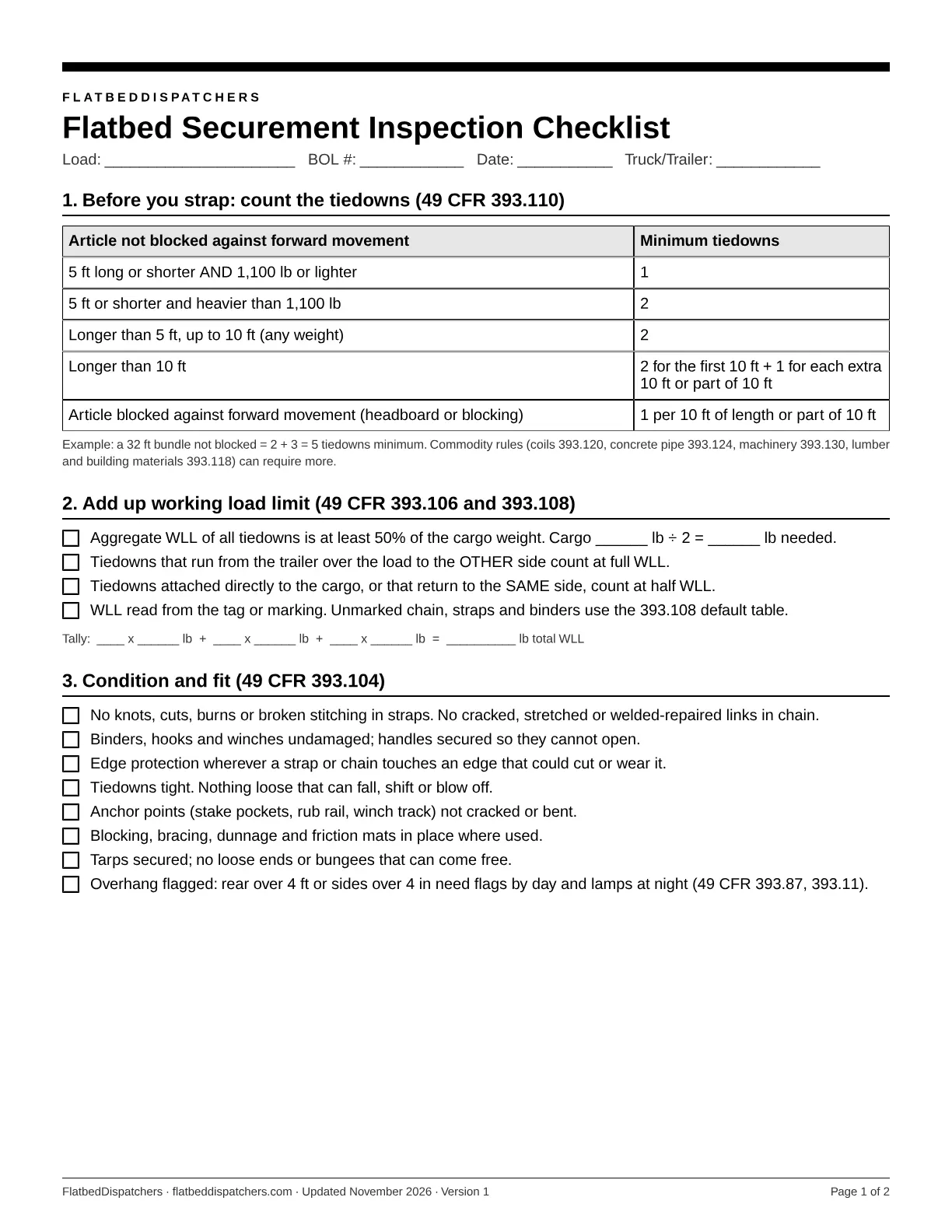
A printable load securement checklist built line by line on 49 CFR 393 Subpart I. Keep it in the door pocket and run it at the shipper and at every re-check. Made for open-deck drivers hauling flatbed, double drop, RGN and lowboy freight.
Updated · File version 1
What is inside
- Tiedown count table from 49 CFR 393.110, blocked and not blocked
- Working load limit tally against the 50% rule in 393.106, with how each tiedown counts
- Condition checks for straps, chain, binders, anchor points and edge protection
- Overhang flag and lamp reminder (393.87 and 393.11)
- Re-check log for the first 50 miles and every 3 hours or 150 miles (392.9)
- Pre-departure checks: photos, BOL weight, permit on board
Direct download. No email needed. Free to use and share with credit; not for resale.
How to use it at pickup
- Count before you pull a strap. Measure the longest article and check its weight on the BOL. The table on page 1 gives the minimum tiedowns. A 32 ft bundle of steel that is not blocked needs at least 5: two for the first 10 ft, then one for each 10 ft or part of 10 ft after that.
- Add up your WLL. Half the cargo weight is the floor. A 40,000 lb load needs at least 20,000 lb of aggregate working load limit. Six 4 in straps marked 5,400 lb WLL each that go over the load to the other side give you 32,400 lb. The same six straps hooked straight to the cargo count at half, 16,200 lb, and that load would be short.
- Look at every piece of gear. A strap with a cut in it, or a chain with a stretched link, does not count toward anything. Edge protection goes anywhere a strap or chain bears on an edge that could cut or wear it.
- Take the photos. Each side, each tiedown, the edge protection, the tarp on, the BOL. If a broker or a claims adjuster asks later, you have it. The load photo checklist lists the full set.
How to use it on the road
The second page is a re-check log. Fill in the first check inside 50 miles, then every change of duty status, every 3 hours or every 150 miles, whichever comes first. Straps stretch and loads settle, especially lumber and anything on dunnage. Write down when you retightened. A filled-in log is a simple way to show an officer or a shipper you did the checks.
Where the rules come from
Every line on the checklist points to its section in 49 CFR 393 Subpart I or 392.9 so you can look it up. Commodity rules for metal coils, concrete pipe, lumber and heavy equipment add requirements on top of the general rules, so read the section for the freight you are hauling. If you are working out what a steel load weighs before you strap it, the steel plate and beam weight calculator does the weight and the tiedown count together.
Sources
- 49 CFR 393 Subpart I: Protection Against Shifting and Falling Cargo (eCFR) (checked November 2, 2026)
- 49 CFR 393.110 minimum number of tiedowns (eCFR) (checked November 2, 2026)
- 49 CFR 393.106 general requirements (eCFR) (checked November 2, 2026)
- 49 CFR 392.9 inspection of cargo (eCFR) (checked November 2, 2026)
Questions carriers ask
How many tiedowns does a flatbed load need?
Under 49 CFR 393.110, an article 5 ft or shorter and 1,100 lb or lighter needs one tiedown. If it is heavier, or longer than 5 ft up to 10 ft, it needs two. Past 10 ft, add one more for each extra 10 ft or part of 10 ft. Blocked articles follow a different count, and commodity rules can require more. The checklist has the full table.
What is the 50% rule in cargo securement?
The working load limits of all your tiedowns added together must be at least half the weight of the cargo (49 CFR 393.106). A tiedown that crosses over the load to the other side counts at full WLL; one attached directly to the cargo, or that comes back to the same side, counts at half.
How often do you have to check your load?
Within the first 50 miles, then again whenever you change duty status, or after 3 hours or 150 miles of driving, whichever comes first (49 CFR 392.9).
Next load
Rather have a dispatcher handle it?
Our dispatchers read the rate con for securement and tarp requirements before you say yes, so the gear on your truck matches the load waiting at the dock.