Free download · Securement and safety
Load securement photos: the open-deck photo checklist
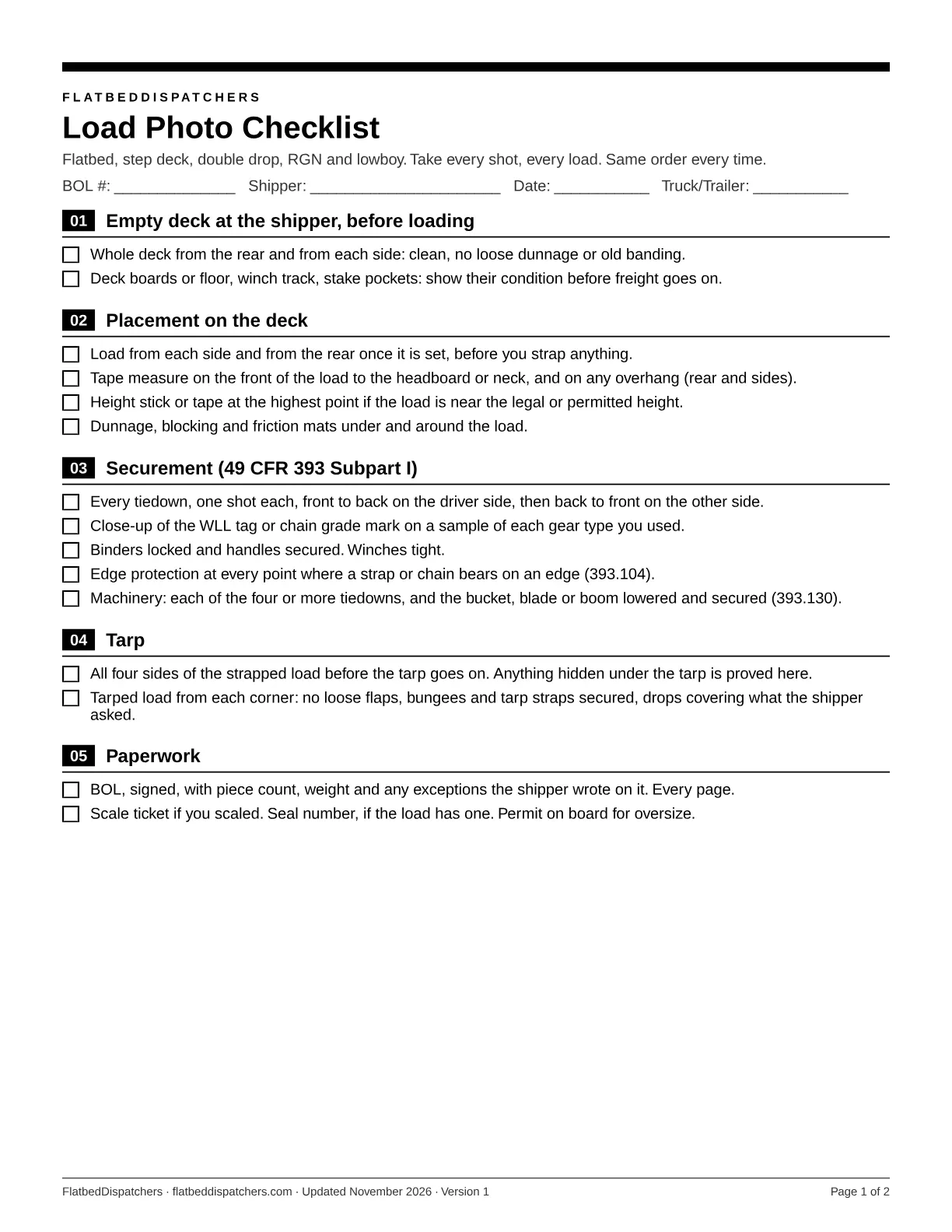
A two-page checklist of the load securement photos to take on every flatbed, double drop, RGN and lowboy load, from the empty deck at the shipper to the signed POD. It includes a file naming convention so every shot is easy to find when a broker or claims adjuster asks.
Updated · File version 1
What is inside
- Eight steps with a code each: empty deck, placement, securement, tarp, paperwork, flags and lights, on the road, delivery
- Shots tied to the rules they prove: edge protection (393.104), machinery (393.130), overhang flags (393.87), re-checks (392.9)
- File naming convention YYYYMMDD_BOL#_SHIPPER_STEP-##.jpg with worked examples
- Storage tips: one folder per load, same-day backup, originals kept unedited
- A short note for new authorities on building a photo set to show brokers
Direct download. No email needed. Free to use and share with credit; not for resale.
Why photos matter on open deck
Your freight rides in the open. Weather, road spray and a loose strap all show up on the load, and nobody else saw how it left the dock. Photos are your record.
- Claims. If the receiver writes damage on the POD, the first question is whether it happened on your truck. A dated shot of the load at pickup, strapped and tarped, plus the BOL with no exceptions, shows the condition it was in when you took it.
- Brokers. Specialized freight goes to carriers a broker trusts. A clean set of placement, tiedown and tarp photos shows how you work faster than any sales pitch.
- Roadside. A securement question at a scale is easier when you can show the re-check you did 40 miles back.
How to use it
- Same order every load. Empty deck, placement, securement, tarp, paperwork, flags, road, delivery. The step codes on the sheet (01 to 08) go in the file name.
- One shot per tiedown. Front to back on the driver side, then back to front on the other side. Add a close-up of a tag or grade mark for each type of gear; the WLL chart shows what those marks are worth.
- Before the tarp covers it. All four sides of the strapped load, then the tarped load from each corner.
- Name the files right away. The sheet uses
YYYYMMDD_BOL#_SHIPPER_STEP-##.jpg, so20261102_BOL481207_SHIPPERNAME_03-07.jpgis the seventh tiedown photo on that load. - Back up the same day. One folder per load. Keep the originals unedited; the time stamp in the file is part of the proof.
For new authorities
A new MC has no track record a broker can check. Pick five clean loads and keep a short set from each: placement, tiedowns, tarp on. Send it with your packet when a broker asks how you secure freight. It is the cheapest proof of competence you can build.
Sources
- 49 CFR 393 Subpart I: protection against shifting and falling cargo (eCFR) (checked November 2, 2026)
- 49 CFR 393.87 warning flags on projecting loads (eCFR) (checked November 2, 2026)
- 49 CFR 393.11 lamps and reflective devices, Table 1 row H (eCFR) (checked November 2, 2026)
- 49 CFR 392.9 inspection of cargo (eCFR) (checked November 2, 2026)
Questions carriers ask
Should truck drivers take pictures of their load?
On open deck, yes, every load. Photos of placement, each tiedown, the tarp and the signed BOL show how the freight left the shipper. If anything is questioned later, a dated photo answers faster than a phone call.
What photos should you take at delivery?
The load on arrival from each side while it is still tarped and strapped, the seal if there is one, the load untarped before unloading, close-ups of any damage with a tape measure for scale, and the signed POD with any exceptions the receiver wrote.
How long should you keep load photos?
There is no single federal rule for load photos. Keep them at least until the load is paid and no claim is open, and ask your cargo insurer and the broker how long they want them kept. Cloud storage makes keeping them for years cheap.
Next load
Rather have a dispatcher handle it?
Our dispatchers keep the rate con, BOL and your photo set together for every load, so when a broker asks about a claim the answer is already in the file.