Free download · Securement and safety
Working load limit chart for chain, binders and straps
A printable working load limit chart with every default WLL table in 49 CFR 393.108, in pounds and kilograms. Hang it in the shop or keep it in the truck. It is the number you use when a chain, strap or rope has no readable tag, and the reference for how the regulation counts each tiedown.
Updated · File version 1
What is inside
- Welded steel chain: Grade 30, 43, 70, 80 and 100 in 1/4 to 5/8 in, with the grade marks to look for
- Synthetic webbing (straps) from 1 3/4 to 4 in wide
- Wire rope (6 x 37, fiber core) from 1/4 to 1 in
- Manila, polypropylene, polyester, nylon and double braided nylon rope
- Steel strapping by width and thickness
- The marked vs unmarked rules in 393.108(a)-(f) and a tally box for the 50% rule in 393.106(d)
Direct download. No email needed. Free to use and share with credit; not for resale.
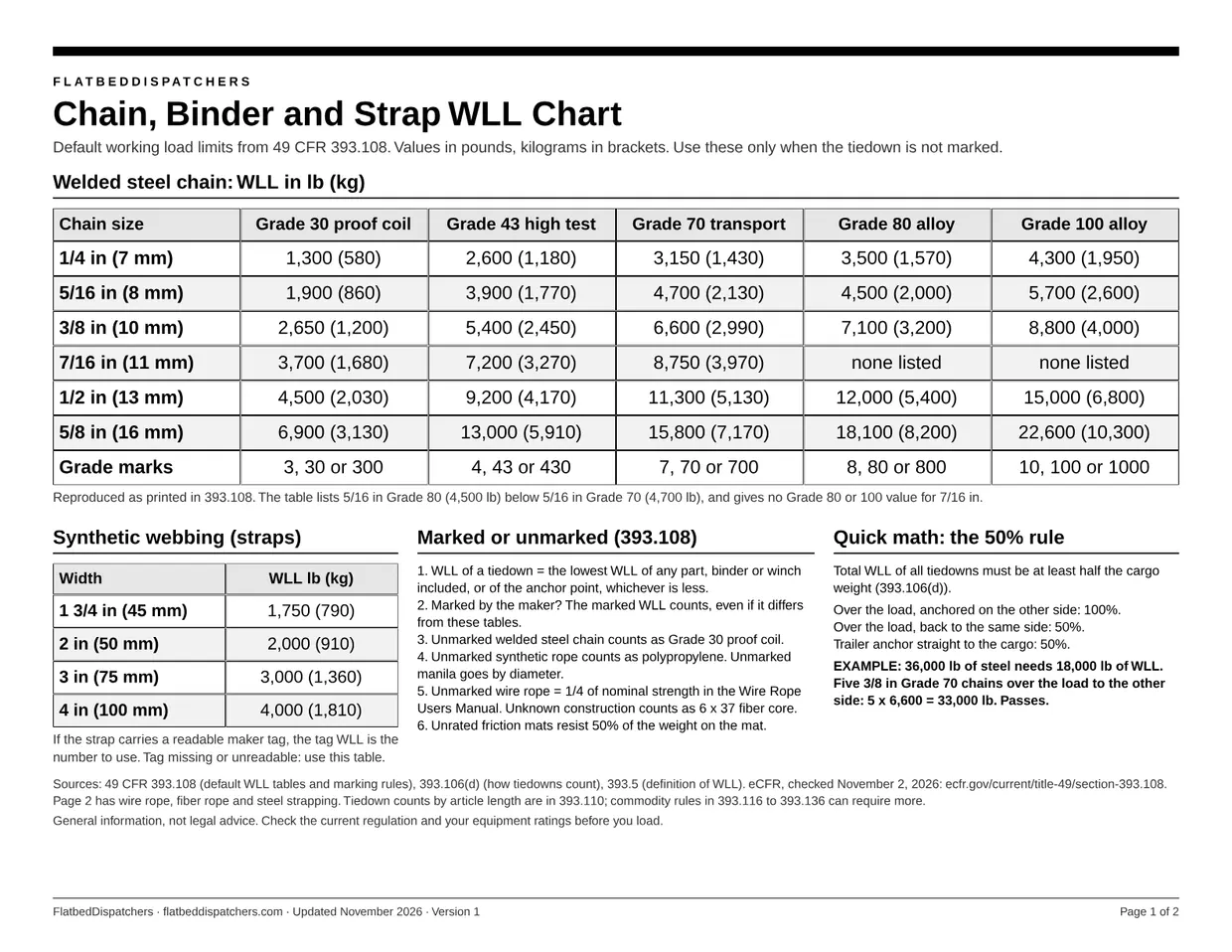
What the chart shows
Page 1 is for the wall: the welded steel chain table by grade and size, the strap table, and the six rules that decide whether you use the tag or the table. Page 2 has wire rope, fiber rope, steel strapping and a blank tally. Every number is copied from 49 CFR 393.108 as printed, including the odd one: 5/16 in Grade 80 is listed at 4,500 lb, below 5/16 in Grade 70 at 4,700 lb.
How WLL adds up
Add the working load limits of every tiedown on the article. The total has to be at least half the cargo weight (393.106(d)). How much each tiedown counts depends on how it runs:
- Over the load to the other side: full WLL (393.106(d)(3)).
- Over the load and back to the same side: half (393.106(d)(2)).
- Straight from a trailer anchor to the cargo: half (393.106(d)(1)).
EXAMPLE. A 42,000 lb load of steel beams needs at least 21,000 lb of aggregate WLL. Four 3/8 in Grade 70 chains over the load to the other side give 4 x 6,600 = 26,400 lb. Passes. Hook two of them straight to the beams and it becomes 2 x 6,600 + 2 x 3,300 = 19,800 lb. Same gear, 1,200 lb short.
The 50% rule is one test. The tiedown count by article length in 393.110 is another, and commodity rules for coils, lumber, concrete pipe and machinery add more. Pass all of them.
How to use it
- Print page 1 and hang it where you sort gear.
- When you buy chain or straps, check the tag or grade mark against the chart. No tag, no higher number.
- At the shipper, run the tally on page 2 before you sign the BOL. The securement inspection checklist covers the rest of the inspection.
Sources
- 49 CFR 393.108 working load limit tables (eCFR) (checked November 2, 2026)
- 49 CFR 393.106 general requirements, aggregate WLL (eCFR) (checked November 2, 2026)
- 49 CFR 393.110 minimum number of tiedowns (eCFR) (checked November 2, 2026)
- 49 CFR 393.5 definitions: working load limit (eCFR) (checked November 2, 2026)
Questions carriers ask
What is the working load limit of 3/8 grade 70 chain?
The default WLL in 49 CFR 393.108 for 3/8 in (10 mm) Grade 70 transport chain is 6,600 lb (2,990 kg). If the chain is marked by the maker with a different WLL, the marked value is the one that counts.
What WLL do you use if a chain or strap is not marked?
Use the default tables in 393.108. Unmarked welded steel chain counts as Grade 30 proof coil, unmarked synthetic rope counts as polypropylene, and unmarked wire rope counts at one-fourth of its nominal strength (6 x 37 fiber core if the construction is unknown). Unmarked webbing goes by its width.
Does the binder need the same WLL as the chain?
The tiedown is rated at its weakest part. Under 393.108(a) the WLL of the assembly is the lowest WLL of any component, tensioner included, or of the anchor point, whichever is less. A Grade 70 chain on a lower-rated binder counts at the binder's rating.
Next load
Rather have a dispatcher handle it?
Our dispatchers check the commodity, weight and securement notes on the rate con before you accept, so you know what chain and straps the load calls for before you roll to the shipper.