Free download · Broker paperwork
Carrier packet checklist for flatbed and open-deck carriers
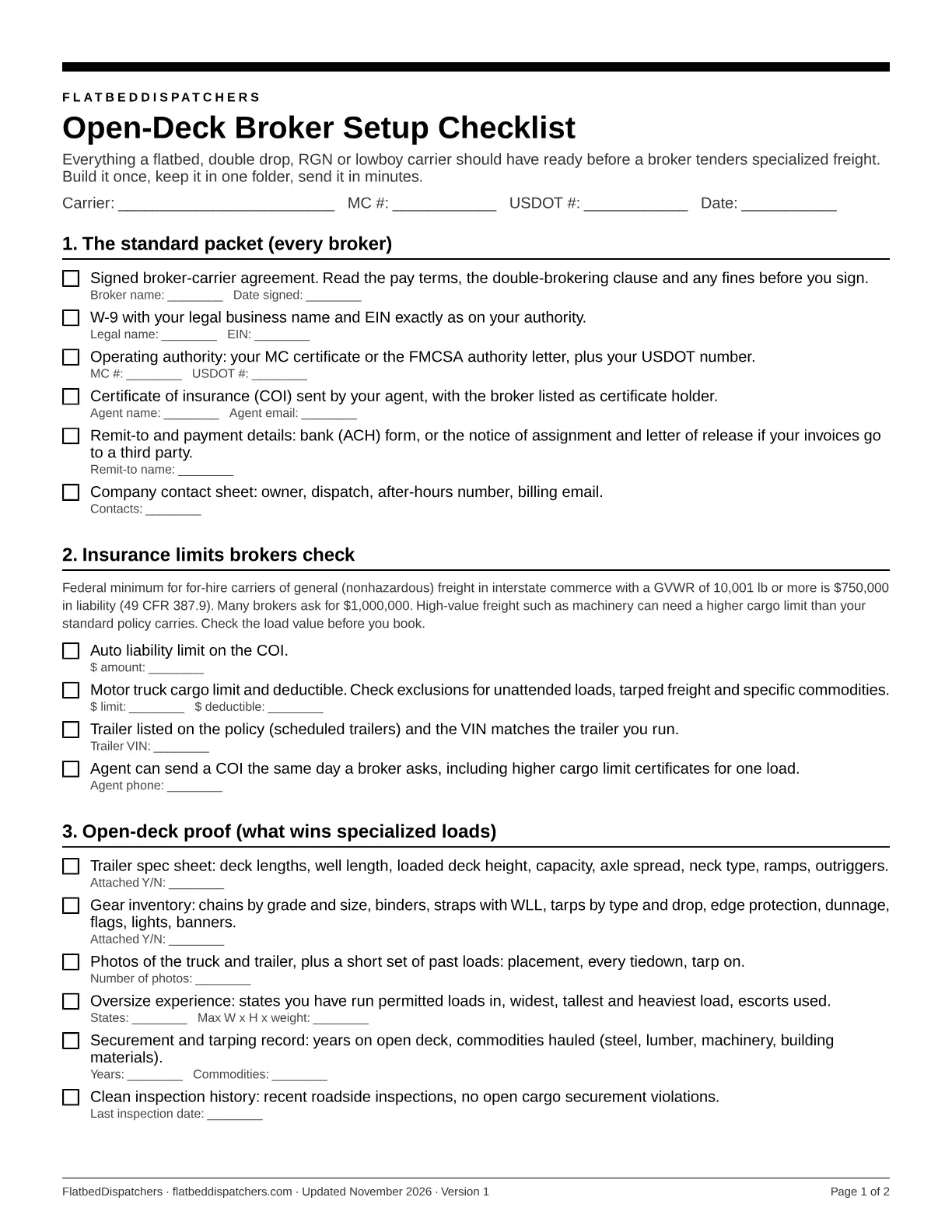
A carrier packet checklist built for flatbed, double drop, RGN and lowboy carriers. It covers the standard documents every broker asks for, the insurance limits they check, and the extra open-deck proof that gets you tendered specialized freight. Print the PDF or fill in the Word file and keep it with your packet.
Updated · File version 1
What is inside
- The standard packet: broker-carrier agreement, W-9, operating authority, certificate of insurance, remit-to details, contact sheet
- Insurance limits brokers check, with the $750,000 federal minimum from 49 CFR 387.9 and the $1,000,000 many brokers ask for
- Open-deck proof: trailer spec sheet, gear inventory, load photos, oversize experience, inspection history
- References and extras for a new MC
- Checks before the first load with a new broker: setup confirmed, rate con, pay terms
- Word version with real headings and [bracketed] fields to fill in
Direct download. No email needed. Free to use and share with credit; not for resale.
Why open-deck setup takes more than a W-9
For a plain flatbed load, a broker mostly checks that your authority is active and your insurance is on file. An open-deck broker putting a 60,000 lb excavator or a load of coils on your trailer wants to know more. Will it fit your deck? Do you have the chain and tarps for it? Have you run a permit load before? The checklist splits the packet into the paper every broker needs and the proof that answers those questions before they are asked.
How to use it
- Build the master folder once. Work down sections 1 and 2. Get the W-9, authority letter and a current COI from your agent into one folder on your phone and your computer.
- Add the open-deck proof. Section 3 is what separates you from the next carrier on the list. Fill in the trailer spec sheet, list your gear, and pull a short set of load photos using the load photo checklist.
- Write down your oversize history. States you have run permitted, your widest, tallest and heaviest load, and whether you ran with escorts. If you have none yet, say so. Brokers find out anyway.
- Check the insurance limits. The federal minimum and what brokers ask for are not the same number. Know your liability and cargo limits, your deductible, and how fast your agent turns around a COI.
- Before the first load, confirm the broker finished your setup, the rate con matches the deal, and you know where the invoice goes.
PDF or Word
The PDF prints on two pages and works as a tick-box list. The Word file has the same content with real heading styles and [bracketed] fields, so you can type your details in once and keep it as the cover sheet for your packet.
Not sure which loads your trailer can take? The trailer match tool checks a load's size and weight against flatbed, double drop, RGN and lowboy decks.
Sources
- 49 CFR 387.9 financial responsibility, minimum levels (eCFR) (checked November 2, 2026)
Questions carriers ask
What documents do brokers need for carrier setup?
Almost every broker asks for a signed broker-carrier agreement, a W-9, your operating authority (MC and USDOT numbers), a certificate of insurance listing the broker as certificate holder, and remit-to or payment details. Open-deck brokers often ask for more: a trailer spec sheet, a gear list and photos of past loads.
What insurance limits do brokers check?
Auto liability and cargo. The federal minimum liability for a for-hire carrier of general freight in interstate commerce with a GVWR of 10,001 lb or more is $750,000 (49 CFR 387.9). Many brokers ask for $1,000,000, and high-value loads such as machinery can call for a cargo limit above a standard policy. Each broker sets its own requirements.
Should I send the same carrier packet to every broker?
Keep one master folder with every document current, and send from it. Each broker still needs its own signed agreement and a COI with that broker named as certificate holder, so those two items change every time.
Next load
Rather have a dispatcher handle it?
Our dispatchers fill out broker setup packets for you from your master folder, so a new broker is ready to tender before the load is gone.