Free download · Broker paperwork
Flatbed equipment list and gear inventory
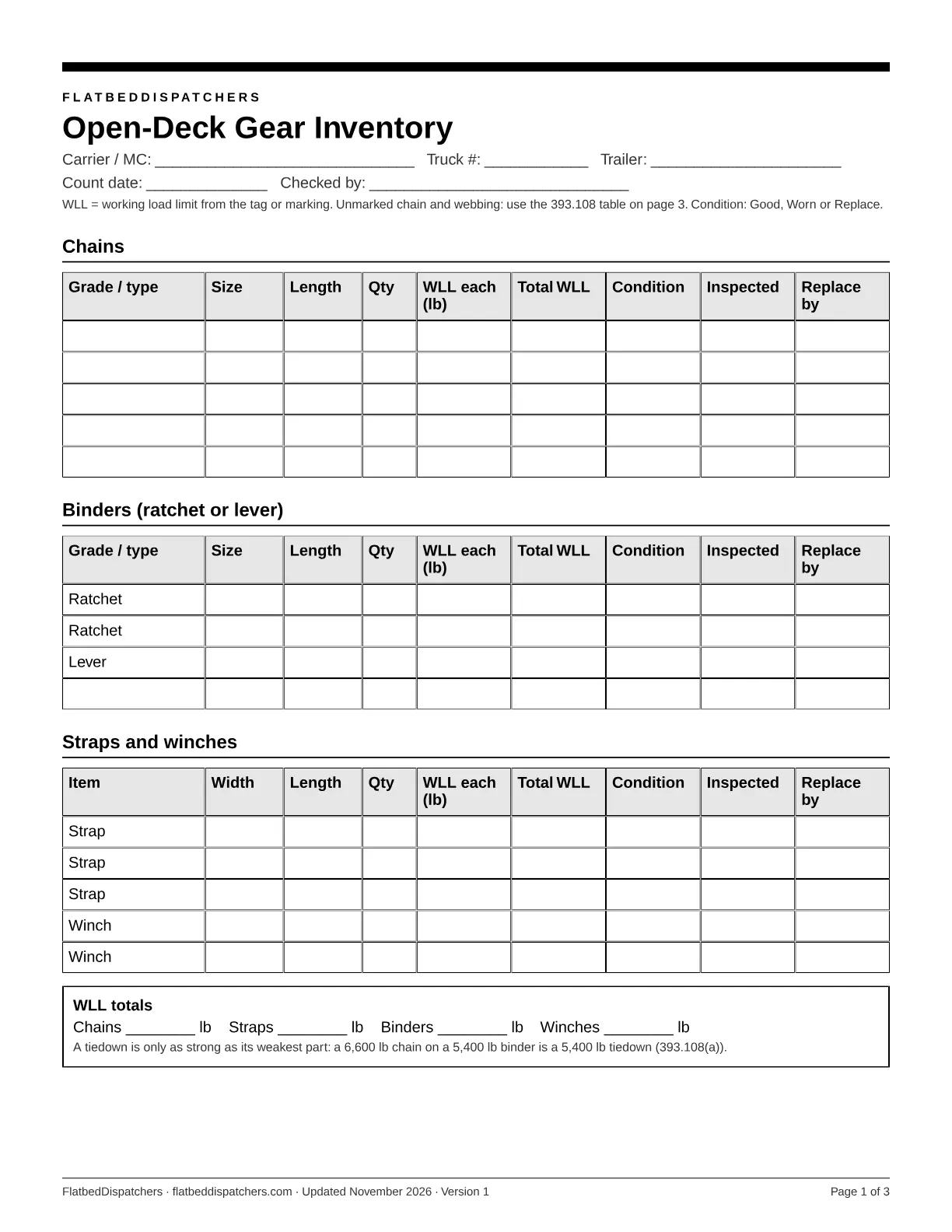
A flatbed equipment list you actually keep current. Every chain, binder, strap, winch, tarp, edge protector, piece of dunnage, flag and light on the truck, with its working load limit, quantity, condition, last inspection and replace-by date. Print the PDF for the side box or keep the Excel version, which totals your WLL by type.
Updated · File version 1
What is inside
- Chains (grade, size, length), binders, straps and winches with WLL each and total WLL
- Tarps by type, size and drop, plus edge protection, dunnage, friction mats, flags, banners and lights
- Condition (Good, Worn, Replace), last inspected and replace-by columns on every row
- The 49 CFR 393.108 default WLL table for Grade 30 to Grade 100 chain and 1 3/4 to 4 in webbing
- Excel: SUMIF totals of pieces and WLL by category, a count of gear marked Replace and gear coming due
- EXAMPLE sheet for a 48 ft flatbed setup
Direct download. No email needed. Free to use and share with credit; not for resale.
Flatbed tools and gear that go on the list
Count everything that holds, covers, protects or marks a load. Chains by grade and size, binders, straps by width, winches, every tarp with its size and drop, corner protectors and strap sleeves, dunnage, friction mats, coil racks, flags, banners and lights. Write the WLL off the tag. Gear with no tag counts at the default value in 49 CFR 393.108, and unmarked welded chain counts as Grade 30 proof coil, the lowest grade in the table.
A tiedown is only as strong as its weakest part. A Grade 70 3/8 in chain is 6,600 lb in the table, but hook it to a binder tagged 5,400 lb and that tiedown is a 5,400 lb tiedown (393.108(a)). The sheet lists binders on their own rows so you can see which part sets the limit.
How to use it with brokers
Brokers moving machinery, steel or anything tall and expensive want to know you can secure it before they tender the load. A current gear list answers that in one page. Send it with your trailer specs when you set up with a new open-deck broker, or when a load asks for something past your usual setup: extra chain for a dozer, coil racks, a smoke tarp.
If the list says eight chains and the machine needs ten, you know before you say yes, not at the dock. Run the load's dimensions through the trailer match tool to pick the deck, and lay out multi-piece loads in the deck space planner to count how many tiedowns each piece needs.
Keep it current
Recount at every PM service or once a month. In the Excel version a row marked Replace counts zero toward your WLL totals, and the summary shows what comes due in the next 30 days, so a cut strap does not stay in the box.
Sources
- 49 CFR 393.108 working load limits (eCFR) (checked November 2, 2026)
- 49 CFR 393.104 standards for cargo securement devices (eCFR) (checked November 2, 2026)
- 49 CFR 393.130 heavy vehicles, equipment and machinery (eCFR) (checked November 2, 2026)
- 49 CFR 393.87 warning flags on projecting loads (eCFR) (checked November 2, 2026)
Questions carriers ask
What equipment do you need for a flatbed?
Chains and binders, straps and winches, tarps for the freight you haul, edge protection, dunnage, friction mats, and red or orange flags for loads that stick out. Oversize work adds OVERSIZE LOAD banners and warning lights. How much of each depends on your freight: steel coils, lumber and machinery each have their own sections in 49 CFR 393 Subpart I.
What securement gear does flatbed equipment hauling need?
A machine of 10,000 lb or more must be held against forward, rearward, side and upward movement with at least four tiedowns, attached as close as practical to the front and rear or to the maker's tie points (49 CFR 393.130). Accessories such as buckets and booms must be fully lowered and secured. In practice that means transport chain and binders whose WLL adds up for the machine's weight.
When should a strap or chain be taken out of service?
When it is damaged or weakened in a way that affects how it holds: cuts, burns, knots or broken stitching in a strap, cracked or stretched links in chain, binders or winches that slip. Securement devices must be in proper working order (49 CFR 393.104). Mark it Replace on the sheet and pull it off the truck.
Next load
Rather have a dispatcher handle it?
Our dispatchers keep your gear list on file and check each load's securement and tarp needs against it before you say yes, so you never roll up to a shipper short of chain.